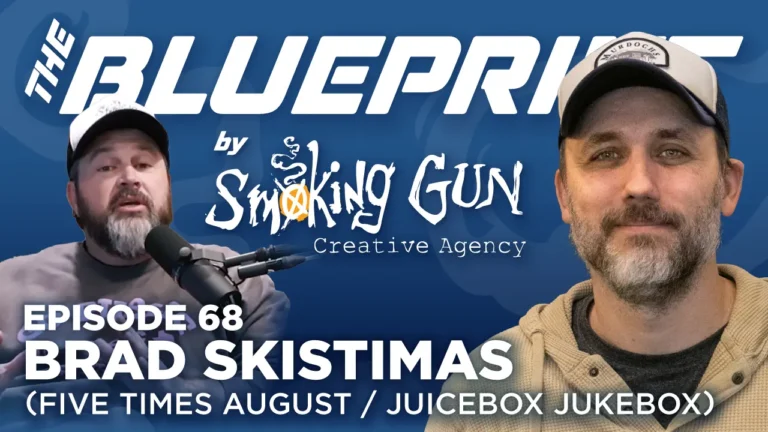
This week, we’re talking with Brad Skistimas – the musician behind Five Times August and Juicebox Jukebox. Brad’s telling us about his 25-year journey in the music industry, from high school talent shows to having songs featured on MTV. He pulls back the curtain on the harsh realities of the music business and also goes in depth about his unexpected creative pivot to becoming a “protest artist,” and all the related challenges along the way.
0:00 Creative Roots and the Family Business
10:38 Brad’s Path to Music
23:00 Early Songs and MTV
27:25 My First Big Failure
36:00 On Becoming a “Protest Artist”
1:08:35 Juicebox Jukebox: Creating Quality Music for Kids
1:24:55 Wildcard Off Topic Discussion
1:33:05 On AI in the Art World
Transcript
They had a, a warehouse, you know, growing up where I could, as a creative little kid, just sort of make whatever I wanted. If you go to your parents and say, “Look, I’m gonna be a musician,” for most people, that does not go over well. The very, very early Five Times August songs, they were all break-up songs- Mm-hmm. because that’s what I was going through and, and- Mm-hmm. and so I was pulling from that place. And each, each song, each album, you know, gets you from one place to the next, and you learn as you do. But I think I got trapped in a circle, just trying to write a pop love ballad or b- ballad for a really long time. Mm-hmm. Trying to be John Mayer. I worked with what was called a ghost label, who allowedYou basically pay for the major label experience, which was, like, my first big failure. Mm. Everything was growing and was great up until then, just bled me dry, because you’re working with all these people who tell you you’re great- Mm-hmm. until you don’t have any money. Just follow your gut. Even if the next project that you do as a creative indi- individual is completely different and doesn’t match your branding, it’ll take you to the next thing after that, and that’s okay. Hey everybody, welcome back to The Blueprint. Today I have Brad Skistimas, who is a singer-songwriter, uh, with a band called Five Times August. Really excited to hear this guy’s story. He’s got a lot going for him. Really unique story. Let’s dig in, see what he’s got. But if you guys would do me a favor, sub- hit that subscribe button on the bottom. It’s gonna let me get a lot more of these stories out there. Uh, appreciate your support. Thank you. Hey Brad, thank you for coming on the show today. I really appreciate it. Absolutely. Thanks for having me. Yeah. You know, have you ever had anybody that had, like, a really bad lisp, and then they tried to get the full name out? Mm-hmm, mm-hmm. How’d, how’d that go over? Brad Skistimas. Yeah. It’s okay. You’re not alone there. Yeah. I’m just imagining Mike Tyson, like, trying to throw that down one time. Brad Skistimas. Yeah. No, that’s been a thing my whole life. I mean, since grade school, you know, e- evenWhen I would have a, a teacher that would, uh, call r- roll call, we’d have, like, a substitute or something- Mm-hmm. and, and my name was just one letter shy of fitting on the little sheet- Hm. so they’d al- Hm. always say Skistima. Mm. So I was Brad Skistima all the way through 5th grade. Yeah. So, you know, it gets in my roots. Yeah. personally. What were theWhat were some of the words that the, or the names kids called you? Some of the names kids called me? Yeah. Um, in like a bully aspect or- Yeah, bully aspect. I didn’t really get bullied, I don’t think. I mean, i- you know, thehad aI did work with a guy that just called me Brad the rad dad all the time. Hm. That was much later than elementary school though. Yeah, that’s cool. That would have been weird in elementary school-for somebody to call me Brad the rad dad, butNo, they al- or, I mean, you coulda been, you coulda been the cool guy in school at that point. That’s true, yeah. Um, you know, I always find when, uh, people got unique names, people always try to pair them up with something. Brandon Tandon, Adam Zapple, you know. Yeah. No, it’s usually, you know, they’llThey instantly go to Christmas. Okay. They’ll be like, “Oh, Skistimas, like Christmas. “Okay. Or they’ll say, you know, “Mr. , Mr. Christmas,” or, “Mr. Skismas. “It’s some variation. I think the- Yeah. name itself is enough to play with that- Yeah. You get all kinds of stuff all the time. Yeah, surely. Well, where are you from? Where’d you grow up? I grew up in the Dallas-Fort Worth kind of metroplex area. Mm-hmm. I grew up, um, in the Highland Village, Lewisville area as a kid. We moved to Flower Mound- Mm-hmm. and that’s kind of where my, my childhood took place up through high school. Okay. And, uh, moved to, uh, Denton from there. Denton, Texas. Mm-hmm. Then moved down to Austin for a year- Mm. and now I’m in the Waxahachie area. So I’ve always been kind of, you know, right up and down 35. Nice. Yeah. So family, family as a big family, a small family? A decent sized family. I’ve got 2 brothers, a sister. So- Okay. 6 of us growing up. Christmases were crazy? Skistimas Christmas, baby. Yeah, it was good times. Um, you guys and your family pretty close? Yeah, I think we’ve done a pretty good job of, of staying close over the years- Mm. and I’m actually looking to move back to that area now- Mm-hmm. with my kids getting older and my family being kind of still in that Highland Village, Lewisville area. Mm-hmm. So we’re actually kind of, this year, kind of going, “Well, maybe it’s time to go back. “Mm-hmm. Mm-hmm. It is funny how, like, you know, you get used to things and you call things home, right? Mm-hmm. And that term just means, like, where the family’s at, right? It doesn’t really- Mm-hmm. mean, like, the location or a city or a town, but it’s like your people, right? And so, uh, the, the closer we get to making our true nest or- Mm. where our kids grow up, it seems to be that we try to get closer to home for the most part. Mm-hmm. You know, and you, you got a pretty tight family that you wanted to gather them back around. Some people run, you know. Yeah, I mean, that’s the thing. I mean, I do haveI’ve gotMy oldest brother lives in California- Okay. and my sister lives in Lubbock, but, um, my other brother still lives there, my parents live there, my wife has a cousin that lives there. Uh, my best friend growing up, uh, he still lives out there. Mm-hmm. And good schools and stuff, and- Mm-hmm. and that’s what’s kind of funny is I’ve lived in Waxahachie for 20 years this year- Mm-hmm. and I’ve loved it, I’ve called it home, it still feels like over there is still home. Right. You know, that childhood time, like- Yeah. hits you just right ’cause- Mm-hmm. like I lived in Highland Village for 4 years, but they were like the pinnacle of childhood, those 4 years of just- Yeah. like going to your friend’s house and making all those memories. So, um, yeah, I’m looking forward to it. Hopefully we can find a house. Market’s crazy, but- Mm-hmm. umYeah, a lot’s happened between, um , then and now, so. Mm-hmm. What about, what about your parents? What did they do? So my parents, uh, I grew upMy, my dad was an illustrator early on. Okay. Um, did like corporate illustrations and stuff like that. And then, um-in the l- early ’90s, my parents started a business together, a event decorating business, which grew, uh, substantially over the years. They wereThey ended up doing, like, large-scale, uh, parades, Thanksgiving parades, doing, uh, designing parade floats and stuff. So they had a, a warehouse, you know, growing up, where I could, as a creative little kid, just sort of make whatever I wanted. There was wood and metal everywhere, and- Mm-hmm. you know, you could just, kinda just design what you want, try it out. Uh, me and my friend tried to make a guitar one time. Yeah. It wasn’t very good, but, you know, it was such a, a playground that I kinda took for granted. Mm-hmm. I was pulled into working with them all the time, and- Mm-hmm. this was just my life. Yeah. You know, going to do parades and things- Mm-hmm. like that, that I didn’t really, I didn’t really connect how special that was ’til- Mm-hmm. years later. Mm-hmm. And my dad would pick me up from middle school in a big Ryder truck filled with, you know, whatever it was that we were installing. Mm-hmm. So, um, you know, it, it was a very unique upbringing, and, uh, I was just around creativity a lot. And my parents really nurtured that creativity. Mm-hmm. You know, no matter what it was that I was into, they would always allow me to explore and do those things, whether I was into magic, you know, for a little bit- Mm-hmm. or, um, once I found a guitar, I mean, that was it for me. Yeah. But, um, yeah, they’ve always been my, my number one fans, so that’s beenI’ve been very blessed in that sense to kinda grow up in a very creatively nurturing environment. Mm-hmm. And then to pursue something that, if you go to your parents and say, “Look, I’m gonna be a musician,” for most people, that does not go over well. Sure. Yeah. But for them, you know, um, i- uh, to their credit, they, they let me go at it. Mm-hmm. And here I am, you know, 20 years down the road since, you know, really starting out 25 years now. And, and, uh, still, still doing it. Still rolling. Yeah. When you said, umWere you the only one they took on to, uh, ma- uh, to help work out in the, uh, in the shop? No. It was kind ofIt’s, it’s kind of a rite of passage. Mm-hmm. I mean, i- it was for all of us growing up, and then it kinda, it kinda bled into pulling in our friends on jobs. And then as we became married, our spouses would end up going on jobs. So it became a rite of passage in our family to sort of go and do a, a job, uh, with my parents, ’cause they would, they would always need help doing something. And so that’s been pretty cool. And in fact, my dad needed help doing an installation over Christmas, and- Mm-hmm. and, um, you know, my, my 2 boys got to go and help out Grandpa, so I was like, “You’ve got to. “Ah, that’s very nice. You know, itThe story continues, so. Passing the torch. Yep. Uh, did youI’m guessing you learned how to fabricate with welding and, and woodwork as well? Did a little bit of welding here and there. Wasn’t very good at it, but- Mm-hmm. I got to do it, which is really neat. Yeah. Um, wood cutting, drilling stuff, um, I got really good with an X-ACTO blade- Mm-hmm. Did a lot of signage work. Yeah. Um, I mean, you name it, they did it. They were doing restaurant openings. They did Michael Jack- uh, Michael, Michael Jackson, Michael Jordan’s restaurant opening in Chicago. Hm. Uh, traveling around. Um, theyI mean, gosh, I can’t even count, but l- the really cool thing was doing the, the TV parades, I think, growing up. Mm-hmm. Um, that was something that you could actually go back and watch, and- Macy’s Day stuff. Huh? Macy’s Day and stuff like that. Uh, it kindaLike, along that lines, Adolphus Children’s Parade here in, in Dallas was- Mm-hmm. one that we did. We flew out to Seattle, um, for, I think, 4 or 5 years every year around, uh, Thanksgiving. Mm-hmm. Did a Thanksgiving parade up there, and- Mm-hmm. um, just really cool experiences that, um, like I said, like, at the time, I didn’tWasn’t ’til I got older that- Mm-hmm. I was like, “Wow. “You know? Mm-hmm. And all the times I kinda resented my dad for pulling me in as a teenager. Yeah. When you’re, you know, you’re at the age where you’re like, “I’ve got better things to do. “Yeah. And then years later, I was like, “Wow, that was a very, like, Mr. Miyagi kind of experience-” Yeah. ” where I was learning so much-” Yeah. ” during that time that I di- that “Like, it wasn’t until I got away from it and grew up that I was like, “Wow, I have all these skills now. “Mm-hmm. “These creative skills which parlayed into everything I needed to become a self-sufficient indie musician. “Yeah. So once I started recording my songs at home and was doing that, I wa- I already had graphic design skills, and so I could design my own CD artwork, and I was printing it out and, you know, then it became, “How do I market this CD? “Mm-hmm. “And how do I do that? “And, and I just became very, um, eh, just very keen on teaching myself how to do the things I needed to do- Mm-hmm. on my path as I needed it. Mm-hmm. Which, uh, was another thing I did- I just thought that’s what you did. I mean, observing my parents create their own business- Mm-hmm. and become successful with it set a tone in my early childhood of just, “Oh, that’s what you do in the future. “Right. You find out what it is that you’re good at, and then you just go do that. So I didn’t go through, you know, high school, into those college years thinking like, “Oh, I’ve gotta think about what kinda job I’m gonna end up doing. “Mm-hmm. Like, when I graduated high school, I was like, “I’m, I’m gonna be a, a songwriter. “”I’m gonna be a recording artist, and that’s what I’m gonna do. “Mm-hmm. And, uh, had no other option, you know? Mm-hmm. That was just the path that I was on. Yeah. And I set out, and that’sThe moment I graduated, that summer, recorded my first little bedroom CD and started playing coffee shops, and inside of 3 years, was getting some licenses to MTV and started touring beyond Texas and j- I just worked my butt off. Yeah. Mm-hmm. Yeah. And I guess that work ethic goes back to what your parents were kinda doing and watching them do this. And as you see the both of them, likeGenerally, you see a, a power couple like that, that is, um, able to, you know, bring up a, a company by themselves. It’s, 1, it’s kind of creative, and the other one’s kinda analytical. Is that kinda the way your family was set up, or were they bothYeah. So, well, they’re both very creative individuals- Okay. in their own, in their own right. Um, my dad would, is, was definitely, you know, the more conceptual person. My mom was the more business side of things. Yep. So she would handle the phone calls, the contracts, um, you know, uh, arranging what time and, and w- doing the install, uninstall, whatever it may be. Mm-hmm. Um, but they both had a, a creative vision. Mm-hmm. That they could both work with, and, um, that ended up, uh, becoming a huge part of m- my life with- Right. when I met my wife. I mean, we met working in radio, and then I wasShe found out I was a, a budding, you know, starving musician, and, um, she started helping me out, and then that relationship grew, and so we became a husband-and-wife, you know, power team like that- Mm-hmm. throughout, you know, I, when I was, by the time I was touring colleges. So, um, you know, and, and that independent spirit is just, you know, it’s something that I think I, I wanted to get away from at some point. Like, you, you eventually, you work with people, and- Mm-hmm. by the time I dipped my toe into working with bigger companies and stuff, I was like, “Ooh, this feels very weird. “Mm-hmm. And I had to really embrace just being a straight-up independent artist. Yeah. So that’s a, that’s a whole other thing, but, umYeah. Well, kinda rewinding that back and- Mm-hmm. and thinking about, um, you know, you said you knew you loved music at some point, right? LikeMm-hmm. You said you tried to make a guitar. Was that the first moment for it, or, like, where did- Mm-hmm. Where’d you get the guitar in your hand for the first time? Mm-hmm. So the guitar came to me, I, I love this story because it really shows you how your actions can impact, um, people you don’t even know, but I had found a guitar in the back of the closet at home that just appeared one day. Like, I was digging around in the house, and I was like, “What is this? “It was sitting back there. It had one string left on it, and I already loved music, and- Mm-hmm. How old were you? I was 11. Okay. And I hadn’t really been that close to, like, what I felt like was a real instrument. Mm-hmm. We had, like, a keyboard at home and stuff- Mm-hmm. but this was, like, a guitar. Mm-hmm. And I was just mesmerized by it, and we happened to have, uh, a coupon book for the city that had 2 free guitar lessons in it that my mom had just bought as, from, like, a fundraiser or something. Mm-hmm. So we went to the local guitar shop and got it strung up, and, um, I, I took a couple lessons there to, to get my, my feet wet in it, and but, but when that guy strung that guitar up and, and played a full chord on it, I was like, “Oh my gosh. “It was like a, one of those magical moments. But the guitar came by way of my grandmother, who bought it for my grandpa in the ’70s, ’cause he played a little bit. Mm-hmm. Not too much, um, but I guess, you know, he had it, it was a nice little gift, and somehow, it, you know, he set it down, and it worked its way into our house, into that closet. But I just thought, “Man, if my grandma had not bought that guitar for my grandpa, how different would my life be right now? “Yeah. Just to have that thing right there- Mm-hmm. right at the time where there was a, this hunger to, to, you know, for music, and you’re not really sure what that is, and then the answer’s right there. Mm-hmm. It was hiding in the back of the closet, and so, so yeah, that was the beginning of it. I was getting intoYou know, I grew up listening to my parents’ records. I was really into The Beatles and-I had a fifth grade teacher that used to play the oldies radio- Mm. and so I was listening to all these old songs, and, um, that was kinda like what I really liked listening to. And, um, I had just gone through a really heavy phase of dancing like Michael Jackson. Mm-hmm. I wasSo, like, there was this entertainer sittingYou know, it was morphing, figuring itself out at a young age- Right. Mm-hmm. where I just wanted to entertain somehow. Like I s- I mentioned magic and stuff, and then I was into dancing, and, um- Get some parachute pants? I, I, you know what? I did. Yeah, baby. I did. Uh, the most embarrassing picture of me- Mm-hmm. is my dance picture from that year-and, uh, we’ll see if it ever reaches the light of day. But it’s a good one. Yeah. Um, but for sure, like, that, that was me. I was, like, trying to figure outI was making home videos with my buddy. You know, we’d make funny little kid videos as you would if you had access to a, a VHS camera. Yeah. Mm-hmm. So, I was doing that kinda stuff. Mm-hmm. And then, uh, y- you know, once I got to the guitar and that guy strung it up like I said and I took a few lessons, like, it was written in stone, you know? This is where I- this is the path I’m on from here on out. Mm-hmm. And, um, you know, that’sI- i- e- even then, like, I had it in me to keep going with it ’cause we moved in the middle of that year, so I couldn’t go to the guitar lessons that I was going to. So I had about 6 months of guitar lessons, then we moved and I had to teach myself from there. We never really pursued looking for other lessons. Mm-hmm. So I was self-taught from there and just kept going with it, and I was about 11. By the time I was, like, 12, I was starting to sort of play with writing my own songs. Okay. And about 14, I was writing stuff that I was kinda like, “Yeah, this is okay. “You know? Like, really”You know, you start to get proud of yourself- Yeah. and, um, then by the time I, you know, I, I played throughout high school. Played guitar for the choir band, um, so, um, got a lot of experience performing on stage and with the band and entered talent shows and stuff like that, so. Mm-hmm. By the time I graduated though, I was just like, “There’s no other, there’s 0 just no other path for me. “And- Were you playing gigs and stuff while you were in high school at the same time? Not really. I, I had a buddy of mine that we would, we would do stuff at school. Mm-hmm. You know, we would find opportunities to play at school, whether it was talent shows or if, if the choir was putting on a, uh, a program- Mm-hmm. we’d ask if we could play something as an opener. Mm-hmm. Um, when, when the, uh, principal retired, we were like, “Can we play? “You know, w- uh, Britney Spears was popular at the time. We playedHis name was Mr. Sigler and we changed the words to Hit Me Sigler One More Time-and played at his pep rally for his retirement, and, and those things were, like, really showing me, like, wow, like, the power of entertaining people and- Yeah. and you get a pat on the back as you’re going down the hallway the next day. Mm-hmm. “Wow, that was really great. “You know? Yeah. And, um, had some f- I had a friend who she was a singer and she asked me to learn, like, 30 songs for a set at a coffee shop, and I really enjoyed that. Mm-hmm. So all these things accumulated over, you know, picking up the guitar. It’s all just, you know, those beginning years where you’re, you’re just doing what you can- Mm-hmm. whatever it is that you can do to play for people. Mm-hmm. And then by the time, yeah, like I said, uh, graduated high school, I spent that whole summer just, like, writing songs and recording them and, and- Yeah. getting that experience going. Did people know you in high school as the musician guy? Or was this kinda something that was justMm-hmm. I think theyTowards the end of high school, I think I got sort of a name going for myself. At least me and my buddy did. Mm-hmm. It was always like, “What are Brad and Jeremy gonna do next? “And so, um, you know, I’ve had friends that have, you know, reached out since then. They’re like, “Wow, I remember when- you know, seeing you play and it’s-” Mm-hmm. ” pretty cool to see how far you’ve come. “So. Mm-hmm. Mm-hmm. What’s Jeremy doing right now? Jeremy is in, in Highland Village- Mm-hmm. uh, he’s a, a creative director for a company, doing f- like, short films and stuff- Okay. or in-house films. And, um, you know, every now and again, we still come back around. ItWe s- we’re still in touch, and we’re still- Mm-hmm. buddies, and we’re like, you know, “One day, we’re gonna “” you know-” Relive it. ” uh, we’re gonna relive it, get back together. “And my kids love watching all the movies we made- Yeah. as kids, you know, ’cause weBack then, you did it just for your own entertainment. Mm-hmm. Like, nowadays, everybody does it for, for clicks and YouTube views and stuff. Right. And we’d, we’d spend a whole day making a movie, and we’d pretend like so many people are gonna see this one day. Mm-hmm. And that’s another thing where I’m like, really, we were only making it for my kids way in the future- Yeah. ’cause they love watching me at their age make- Yeah. these movies, you know? And that’s a really cool thing for this generation to get to see. Mm-hmm. ‘Cause our generation grew up withYou know, we’re really the first ones to grow up with, solid home video documentations of our- Mm-hmm. childhood and- Yeah. and, um, you can really get to know your, your parents that way and who they were when they were your age. So it’s kind of a neat thing toa way to bond with my kids. Yeah. When you guys, you and Jeremy get back together, you guys gonna, uh, bring The Parachute Pants back out orI think so. No, no, we got to at some point. Dude, you gotta relive it. We’ll, we’ll figure out a way to work it in. What was the name of the band? Yeah. It was just Brad & Jeremy. You know? Every ni- Spot on. It was just Brad & Jeremy, but like-every now and again, I think we, we just had fun with it ’cause I think one year, we, we named it An AcousticI can’t remember. It was like, An Acoustic Surprise or something like that-by Brad & Jeremy or whatever. We’d always think of something stupid and lame to put in there. We, we joked, andYeah. Um, yeah, I mean, it was kind of like a comedy music kinda thing, and- Okay, satire stuff. Yeah, yeah, yeah. Mm-hmm. But, but we just had a lot of fun doing it, so. Mm-hmm. Well, so you broke out of that. Mm-hmm. Sorry, Jeremy. You kinda got left behind on that deal. But you went through, and you were like, “All right, now I need to start taking this seriously. I’m gonna start writing some songs. “Mm-hmm. You know, and you spent more timeWhen you go to start writing a song, is it about the lyrics? Is it about the message? Mm-hmm. Mm-hmm. Is it about the tune that goes with it? Like, where- Mm-hmm. where do you start as a musician? it’s different now than it used to be. I think, you know, asNow, it’s very much, what’s the purpose of this song? Mm-hmm. What am I, what am I giving to people with this? Yeah. And that has not always been the case, especially when you’re starting out. It’s, it’s very ego-driven and, and you’re, you’re introvert, introverted feelings you’re trying to pour out into this song and hope that other people connect with you ’cause like, you know, myLike, the very, very early Five Times August songs, they were all breakup songs- Mm-hmm. because that’s what I was going through, and, and- Mm-hmm. and so I was pulling from that place, and each, each song, each album, you know, gets you from one place to the next, and you learn as you do. Um, but I think I got trapped in a circle, just trying to write a pop love ballad or b- ballad for a really long time. Mm-hmm. Trying to be John Mayer or Dave Matthews or Jason Mraz. Like, those were the guys that were influencing me, uh, you know, around that, those early years. Mm-hmm. And that’s what I wanted to be, um, and so I kinda felt trapped in this sorta circle. It served me well. I mean, I had a lot of those songs ended up on, you know, a lot of MTV shows from, from back then, and I was playing colleges, and, and it reallyYou know, it all worked. It, it wasn’t like I wasAnd I was still writing from a, a place that was true in me and what I was living through, and, uhBut I kind of felt like I just didn’t know what else to write about ’cause I didn’t have too much life experience. Mm-hmm. I didn’t haveI mean, I was a starving musician, but I wasn’t starving. Mm-hmm. I was just trying to get my career up and running- Yeah. you know, and I had supportive parents, so I didn’t have, you know, this, this, you know, sort of a- Get out of the house. angsty kind of- Yeah. yeah, like, I’ve got to prove my parents wrong kind of thing. Yeah. And I, IYou know, I don’t think it was until I started experiencingLike, my career was going up and up as I was building it until about, I don’t know, like, by the time I was meeting with record labels and stuff like that. What year is this, you think? So, I started Five Times August in 2001- Okay. right after I graduated, and then, um, 2004, I have like a big break on MTV, and I have this song that’s on a, on the show called Laguna Beach if you remember that show. Mm-hmm. And that song was called Better With You, and it was likeThis was back in the MySpace days and early social media- Mm-hmm. so like, my views are going up. I’m getting likes and follows from people all around the country, and so I, I used that to sort of schedule amy first foray, foray out of, of Texas and schedule a tour, and then I release an album after that, um, in 2005, tour that in 2007. So 2007 through ’08, I’m meeting record labels- Mm-hmm. finally, and, and I’ve jumped around quite a bit already in in-my story, but, uh, I’m trying to, like, cobble together 25 years and go, “Uh? When was that? “Yeah. But, um-Yeah. It was about 2008, I was kinda reaching that point where early on in my career, 2001, I’m sitting there thinking, you know, “wh- how do you become a popular artist? “Mm-hmm. Was very much rooted in the traditional, uh, perspective of, well, you get your record label deal, you know, you get a hit on the radio, you get a manager- Mm-hmm. And I had all these, like, you know, naive expectations, as you do. Right. And over the course of those f- 5, first 5 years or so, I was starting to utilize this new tool called the internet for indie artists. It wasn’t likeThe internet was new, but social media and how you used it to get your work out there- Right. was, like, becoming a really useful tool. And the more I accomplished, the more it got out there, the more I was able to accomplish on my own. So I was booking my own tours, I was touring colleges, my w- I met my wife during that time, and she became my manager. And so the, my perspective of making it was starting to change. Mm-hmm. But there was still this idea that you get to a certain point, it was still, that was still rooted in this traditional outlook on how you go about the music industry- Mm-hmm. which is, well, at some point, you sign to a major label. And I, by 2008, I had, was having those meetings. Mm-hmm. And I wasn’t quite sure I really wanted to do that. So I worked with what was called a ghost label, who allowedYou basically pay for the major label experience. Mm-hmm. Which was, like, my first big failure. Mm-hmm. Everything was growing and was great up until then, and then I, then it just bled me dry, because you’re working with all these people who tell you you’re great- Mm-hmm. until you don’t have any money. Yeah. And I learned real fast. And, and that, like, that was a super valuable experience for me, where I’m, like, naively just like, “I’m gonna be a, a musician. “And, and- Yeah. and everything’s going great- Mm-hmm. and you’re getting these song licenses, you’re touring, and I’m doing all this stuff. And, uh, I hadn’t quite had a, like a, like a, a flat tire yet, you know- Yeah. on my journey. And that was, like, the car totaled, almost- Yeah. to about, about that time, because I had invested a lot in my first real, like, studio album, I paid a bunch of guys to be on it, and was paying for marketing, advertising, radio play- Mm-hmm. and it was all coming outta my pocket. Yeah. And everybody I was working with just was, like, the flakiest of flakes- Mm-hmm. that it ran me dry. Yeah. And then I was, like, kinda sitting there with empty pockets, going like, “Work? “”What did I do? “”What did I do? “Yeah. “I just screwed up everything that I’ve been building. “So that was a, a big thing, a big blow to me. It was about the time I released an album called Brighter Side, and, um, ironically, because it w- it wasn’t, it was kind of a darker time- Mm-hmm. for me to have to sort of start the engine, you know, to rebuild the engine. Right. Because it’s easier now, I think. Um, you know, all these tools have become, uh, commonplace, and they’ve figured themselves out with re- how to create revenue through them. And exposure. And exposure. There’s algorithms, and just all these different, you know, SEO and stuff, that we really didn’t have in place s- asThey weren’t figured out quite yet around that time. Mm-hmm. Right. YouTube wasn’t generating revenue. It was just a portal to put your music out there- Right. andUm, uh, and so, you know, I, I kinda had to re-figure out how to, where to go from there. Yeah. And, um, you know, between 2008, ’09, and ’10, I was kinda having to re-figure myself out, and, uh, so that was, like, a huge, huge, you know, a big fail. Mm-hmm. But I think that you have to have one of those big fails somewhere along the way- Mm-hmm. ’cause that hasI’m glad I went through it. Yeah. ‘Cause I persevered, and it taught me a lot about myself. Yeah, I mean, you’re gonna go through that. And we talked about this earlier off camera. This is who I am, this is what I’m gonna be doing. “Mm-hmm. And then all of a sudden, you set these expectations of how that journey was supposed to go, right? All the way up to the point where it wasn’t going as fast as you wanted, so you mocked it into place with- Mm-hmm. a faux publisher, right? Mm-hmm. Mm-hmm. A faux record label, right? Mm-hmm. Um, a bunch of, uh, yes guys- Mm-hmm. to, to really kinda tell you you’re great until- Yeah. there’s no more money left, right? Mm-hmm. Did your perspective of success change after that moment? Mm-hmm. Mm-hmm. Was it, “I still need to be John Mayer,” or was it, “Hey, man, I’m doing well doing what I’m doing, living. “”I have aspirations for being something. “Mm-hmm. “But, man, what I’m doing right now is still pretty cool and, and, and more than what most are”? Yeah. Yeah, for sure. I mean, it ha- for a while, I think, you know, it was kind of like you’re trying to scoop together the pieces and, and glue back together something that, that was broken. And, um, it, it took me a while to figure out. And in fact, I kinda dropped the Five Times August name for the first time, and I did a side project called Music by Bradley James. And, and also- Back to the high school names. What’s that? Back to the high school names. Back to the high school names, yeah. But, um, you know, itSo I kinda had to, likeI don’t know, it, it just took someYou’re s- you’re sitting there, you’re kinda out of breath, but you did have to kinda look and, and go, “Well, got myself here,” you know. And you do sort of pick up the pieces and, and shuffle along. But it was the first time where I had to, like, do other things to get by since I had started. Mm-hmm. So I had to pick up odd jobs and, you know, do things that I, I really didn’tYou know, that really had made me appreciate a lot of what I had accomplished. Mm-hmm. So, you know, an example was, I, I did, I ended up doing a lot of odd jobs in marketing and promotion, where you sorta get signed up in those companies to go, you know, be out somewhere and, and represent a brand or something. And, um, I had signed up and gotten this position with Google to promote Google Chromebooks. And, um, when they had started out, and the, they, they flew you out to, I think we went to Florida for a training over the weekend. And I was sitting there so wrapped up in my ego that I was like, “Man, I hope nobody recognizes me when I’m out here. “”Like, this is gonna be so embarrassing. “Yeah. And we get, we get picked up at the airport, and they drive us on the bus over to where we’re, the training facility. And I get off the bus, and this guy walks up to me right after. And he goes, “Aren’t you Brad? “And just instantly put me in my place, where I was like- Yeah. And he’s like, “Are y- are you in Five Times August? “Uh-huh. I was like, “Yeah. “And he’s like, “What are you doing here? “Yeah. You know? And, and, like, it just so put me down in my place, of just like, “Well, you know, things aren’t going that well for me right now. “You know, whatever. And then, and then they give you your uniform. Yeah. You know, your Google T-shirt or whatever, and your, your button-up shirt. I’m not a button-up shirt kinda guy with a collar. Yeah. I never saw myself that. And they, you know, like, I’m looking at myself in the mirror wearing this outfit, going like, “Gosh,” you know. But I did what I had to do. Yeah. I mean, it was, it was just that season of my life. But it started to make me reflect on things that maybe I had taken for granted, like, you know, uh, during those college years, playing colleges, when maybe some nights you wouldn’t play for as many people as you wanted, or you didn’t get paid as much as you thought you would or something. You start to go, “Gosh, you know, I was out there still. I was doing it. “Mm-hmm. “I was making my dreams happen. “You know, maybe one night here and there wasn’t as successful as you thought it was, but the overall package was a success. Mm-hmm. So, you know, those things stay with you moving forward. It matures you, it, it pulls you out of this- Mm-hmm. sort of ego that you’re wrapped in. And that’s something that has been an, uh, a theme, I think, throughout my career, is just stripping away the ego to the point, back to your question a few minutes ago, about what I think about when I write and how songs come about. Um, now I don’t write for myself per se. I write songs that I think I would enjoy for sure- Mm-hmm. or that think, that I need, that I think need to be out there. Mm-hmm. But I write songs that sort of go, “Well, what is this song doing for s- for the person? “Mm-hmm. So now, like, you know, I have a kids music project, which, which serves so m- many purposes behind it, you know? Mm-hmm. I’m enriching the kid’s life, I’m, you know, I’m giving teachers something that’s not super annoying to listen to ’cause it’s- Mm-hmm. You know, I try to write songs with, with substance and soul, that’s, that’s not, it’s not your Baby Shark, you know? Mm-hmm. You mention, if, if you mention children’s music to people, they instantly kinda go like- Mm-hmm. “Oh, you know. “Beep, beep, beep, beep, beepity, beepity, beep. Yeah, yeah, yeah. Like, the most obnoxious thing you can think of. Yeah. And, you know, my, my approach with kids music is to just write it as a songwriter- Mm-hmm. not talking down to the kids, but giving them something of value- Mm-hmm. that, um, parents and teachers can listen to, you know, that-doesn’t drive them nuts. They can actually go, “You know, this is actually pretty good. “Mm-hmm. So there’s things like that. And, um, you know, throughout COVID, my songwriting changed substantially- Mm-hmm. because I sort of became a protest artist- Mm-hmm. for the first time in my career, which was something that I never thought I would’ve seen myself as. Yeah. I was gonna say, I, I, when I Googled you at the very beginning- Yeah. the first thing to come up was protest artist. Mm-hmm. Like, that was your label to this- Yeah. to date. Like, that’s what they pigeonholed you as. Yeah. Um, never really, kinda, you know, thought about that being a theme or a genre. Mm-hmm. Mm-hmm. But, um, explain to us how, how someone becomes protest artist and that becomes kind of what their label is. Yeah. It’s an interesting thing, because that’sI never would’ve thought of myself as being any kind of political artist or protest artist. So I wasI had done Five Times August. I, I’d been under that moniker since 2001 up to about, really, 2018. Mm-hmm. And then I started the Juice Box Jukebox, which was my kids’ music project. I’m doing that full bore for 2 years up until COVID hits. That’s where my heart and soul is, and I’m, like, loving it. It’s very re- rewarding. And, um, and my kids are that age too, so like, I was working at home with my kids, pulling them into my music for the first time. It was a family affair in the recording room. And, you know, it was, it was, it was very happy and, and a bright time. Then COVID hits, and I don’t like what’s happening in the world throughout 2020. Mm-hmm. And I’m sitting there going like, “Gosh, like, you know, the government’s saying this, and it doesn’t really make sense. “And I’m starting to question, like, reality and my sort of naïve outlook on life, really. But, um, you know, I kinda shut down creatively, because there’s a lotI had always sat, sort of in this, like, very safe middle ground as an artist- Mm-hmm. up to that point, and I didn’t know what to say, because I knew if I had spoke my mind, I was going to upset a lot of my fan base, a fan base that I had spent 2 decades building up. Yeah. A fan base that, you know, uh, w- was very diverse across the board. And I had friends, you know, in the industry that maybe were more left-leaning or whatever, or other friends that were rightLike, I liked everybody. Mm-hmm. I was very just a middle-of-the-road, live-and-let-live kinda guy. Mm-hmm. But then COVID hit, and, um, I just didn’t like it. So I did- I wasn’t sure what to say, and I sat, kind of quiet up until towards the end of 2020. And I was praying a lot, just going like, “God, what do you want me to say? “And that was a n- a new thing for me, to really be likeYou know, to kind of spiritually partner, you know, with, with, with the Grand Creator, you know, and be like, “What do You want me to say? You-” Mm-hmm. You know? And so I wrote this song called God Help Us All, and it was kind- I justIt was a prayer, really. And it cam- came out of me, and I was saying things that I hadn’t really ever said before in any of my songs. And I put it out there as like, a 5minute song, just me on the guitar, very raw, honest, live performance in my bedroom, kinda hearkening back to my early days. Hmm. I just kinda got back to basics and tapped into this creative energy. And, um, I put that out thinking like, “Well, this will be my one sorta vent and say on the matter of what’s, what I’m seeing in the world. “And, and a- almost as soon as I put that song out, there was a jolt in everything I had done up to that point, where I, I pissed off a lot of people- Mm-hmm. that had been following me for years. and simultaneously, new people were discovering the song that I had put out, saying, “Thanks for saying that. “I felt really alone. Mm-hmm. And it was, it was kind of the first time, like i- i- the more I had gotten those messages of people, it, it was very bipolar, and, and you felt very alone for a little while, ’cause I would tell my wife, like, “I think I’m burning down everything I’ve, I’ve tried to build, or I’m building something new. “Hm. And so I kept kind of leaning into it, more so the, leaning into the side of, like, people telling me, “Thank you for saying that,” because I needed to hear that. I felt like I was going crazy. I was calling out the government, and what, what we were seeing, and, and the compliance that was happening. And, um, and so I was losing fans and then building this whole new base of people that really got what I was trying to say. And from one song to the next, as I started releasing those songs, I was tapping into this artist side of me that stopped caring what people thought, and, and stopped playing it safe, and really tap into this raw, that sort of angsty thing that- Mm-hmm. had kind of always been missing from the pop side of things. Yeah. And, um, it really toughened me up, and I tapped into an artist that was in there that I never thought I would be, you know? Some’cause I kind of grew up observing those, you know, anti-establishment rock and roller guys as, like, “Oh, they’re cool. That’ll never be me. I’m not that-” Yeah. kind of guy. “Mm-hmm. And I’m still not really that kind of guy. I’m just a dad, and I was really just singing about what I thought was, was true, you know? Mm-hmm. And, and that’s, that’s the point of art anyway, to r- you know, the, it’s the artist’s, um, observations and reflections of what they’re seeing in the world. So as people were telling me, “Thank you,” um, you know, “Thanks for saying this in your song,” it let me know I wasn’t alone, and I kept leaning into it over the course of those next 2 years and ultimately had this album called Silent War that, um, it took me all over the world. And it took me to stages I never would have guessed. I played on the steps of the Lincoln Memorial at this rally, uh, for 35,000 people, and, like, you’re standing there going, like, “Never woulda, never woulda guessed I’d be here-” Yeah. “but here I am. “And- Yeah. um, toured Austria with a lot of outspoken doctors, and, and, uhYou know, so I sort of, to me, it wasn’t a political message. Mm-hmm. But it, it did become, the, the world has become so polarizing that- Right. if you disagree with anybody about anything, it becomes political. Yeah. So I became an activist, of sorts, but really I was just speaking out on what was important to me. Mm-hmm. So, um, you know, but it, it made me stronger, and, and now I can sort of take that experience and move ahead with it, you know? Yeah. It’s another one of those things where, you know, I, I feel like I was, it was helping me wrap up a lot of loose ends that, with Five Times August, that I never quite achieved, like- Yeah. “Oh, this is what I was really trying to do for a long time, really-” Mm-hmm. ” connect with people, uh, in this way. “I think, I think what you’re saying right there, I really loveAs an artist myself, I really love to hear this. These are things that I struggle with as well. I’ve worked a long time building my base up and knowing that there’s 2 sides of the room that I have friends in, right? And I’ve always tried to play it safe as we go through this world of, like, “Uh, you know, there’s things I could say about so-and-so, but, man, do I knock down this house of cards by-” Mm-hmm. ” playing this hand,” right? Mm-hmm. And I’ve, I’ve always been so jealous, literally jealous, of artists that go out and speak their mind with no fear of repercussion, right? Um, there’s an artist out there that I’ve always followed, um, liked. I’ve gone off the rails of recent, but-at the end of the day, like, Kanye West. Mm-hmm. Love him or hate him-he tells you exactly, fear-free, of who he is. And gives you an opinion, you know? And, and I always thought to myself, like, “I wish I could do that. “”I wish I could stand up. I wish I could say, ‘Here’s this, here’s that. This is the raw feeling behind this. ‘” And I think, you know, even my art would l- would change dramatically, is that the things I’m producing and- Hm. the things that I want to say, because some of the biggest hits that I’ve had have been real raw life moments, you know, that I’ve just depicted in art. And to hear you say that, like-I don’t know, I think so many people really need to focus on hearing that. Mm-hmm. It’s authenticity. Yeah. You know? It isThere is nothing wrong with saying something. The true problem with people is not having the ability to hear something- Mm-hmm. without having to act one way or the other to it. Right. You know? We all have a voice, but I don’t have to shame you or tear you down because your voice isn’t my voice. We need to be able to say things. That’s what makes us great. Yeah. And we need to be able to listen to other people and their sides, right? Mm-hmm. And so I’ll just say kudos to you, man. Like-that- Oh, thanks. that’s very powerful and it means a lot to me to hear someone say, like, I- Mm-hmm. you know, not meaning to do this, I just did this because it was in my heart and I- and I wanted to throw this out, so. Mm-hmm. Yeah. Yeah, it’s interesting, you know, when you do that because I, you know, I put that first song out thinking, like, my safety net was, naively, like, “Well, th- those that have been following me should know where my heart is. They shou- you know, they should know, like it’s, they- they might at least hear it. “They’re like, “Oh, I’ve never heard Brad sing like that before. I wonder what drove him? “And you, like, I got some angry emails where there was no conversation to be had. Mm-hmm. And I’m sitting there, to your point, going like, “I’m not closing the door on you. I just- Mm-hmm. wanna put that out there. “Yeah. “You’re walking away from me, you’re deleting my music. “Yeah. “You’re welcome back at any time and I will- Yeah. have that conversation with you and tell you why I feel the way I feel. “So that was a very jarring thing to have to deal with, and- and, you know, I wasn’t the only one, you know, speaking out at that time in music, and- and that was another silver lining of that experience, was finding other artists thatand making friendships with- with other guys that took that same risk, and we had sort of, you know, this awesome sort of moment that we, cultural moment, that we hadn’t seen in a while, since like, the ’60s. That was like, a moment I felt like, you know, if more artists had really spoke out at that time instead of just falling in line and com- Mm. and complying with things, um, uh, you know, is a very valuable moment that kinda went to waste. Mm-hmm. But, um, for those of the artists that did speak out at that time, you know, I- I- I respect them so much, and- and many of them, you know, we became friends with one another. But we all kinda went through that together where, like, you- you say this thing, you’re kinda nervous about it. Hm. You get very angry emails, you feel very alone, and then this trickled-in effect of- of people starting to take notice that feel like you come and put the Band-Aid on it, and they make you feel better, and then- and then you sort of, you don’t even worry about that other side of, that ugly side of things anymore, where people- Mm-hmm. you know? And- and the more I thought about it, I was like, “Why do I feel like that? “I listen to so much music that- Mm-hmm. I don’t agree with, you know, this artist or that artist, or their lifestyle, or whatever it may be. But I can still appreciate what they’re creating. Mm-hmm. You know? And if I don’t, I don’t have to listen to it, I don’t have to make a stink out of it. Right. But I was also, like, trying to make the point to people, if you’re gonna, like- like x me out of your music library, uh, because you don’t like one line in a song that I wrote, you’re gonna have a lotta work ahead of you going through the rest of your iTunes library. Right? Likeyou better start going through, like you- Pay attention. you- yeah, you’re only mad about it because you just now came, you saw it and you noticed it, and you’re thinking about it, andYou know, it’s a silly way to behave, because what I long for is that pre-COVID era that we kinda grew up with in the ’80s and ’90s really, where you could disagree with somebody politically and still be their friend. Mm-hmm. And it’s just got, it’s- it’s- it’s fallen off the wagon, it’s just gotten crazy. But, um, yeah, it’s- it’s an interesting thing to go- go through that experience where you really try to be safe for a long time, and even with that first song I thought I was kinda being safe, God Help Us All. And, you know, I think my, the most controversial line that I think I put in that song was a lyric that said, “Mask up, vax up, get your body trashed up,” which w- w- nobody had heard me say something like that- Hm. before. And, uh, especially at the height of masking and- and the- the vaccines being rolled into place. But it- it jarred something in a lot of people. Mm-hmm. And, um, you know, the song after that was called Jesus, What Happened to Us? you know, the song after that was called Jesus, What Happened to Us, which was a even deeper focus on what the state of the world. And then I had crazy people commenting on those, and I wrote a song for them called Outta Your Damn Mind. And then, you know, uh, th- i- if you listen to that record, Silent War, from top to bottom, they’re all, the songs are all in the order in which I wrote and released them throughout that time. Mm-hmm. And it tell, you can hear me get more aggressive and more, like- Clap back. Yeah, yeah, yeah, for sure. Like, the 4th song in it is called I Will Not Be Leaving Quietly, and it was basically like, “Look, like, I’m gonna get louder. “Mm-hmm. “And I’m not, I’m, you’re not gonna shut me down. “And- Yeah. And it kinda stirred something up wi- in me that was a lot of fun too, as like, it kind of reminded me of, like, my younger days when I used to be, like, the annoying little brother to my, my bros or something, where you’d do something kind of with this little antagonistic sorta- Mm-hmm. poke, and be like, “Well, if you’re gonna”If that one got you. If you’re gon- yeah, like, well, here you go, and- Yeah. And so, you know, it wasn’t that I was intentionally trying to push knobs. It just sort of was fun to play with that. Mm-hmm. Especially as things were getting censored. And that was a whole other exercise in creativity as an artist ’cause you’re seeing friends, like some people would write niche songs during that time about masking or vaccines or whatever, and, and it’d be very blatant, and they’d get, uh, censored- Censor nerf, yeah. and it’d get pulled down. And I would try to get a little more creative with it and not even say those words, you know? Mm-hmm. As, as the songs rolled on, and, um, a- and, uh, sometimes the algorithms would pick it up and you’d get censored or something. Mm-hmm. Um, I mean, that was the big thing. I wrote a song called Sad Little Man about Anthony Fauci. Mm-hmm. And that went viral, and that put me into another stratosphere of, oh wow, like, that censorship that you hear online- Mm-hmm. or that anger, those anger, a- a- angry comments and attacks, personal attacks, people looking up your private info- Yeah. ‘ ’cause you said something that upset, that’s all real. Mm-hmm. And I had put that song out at the height of, you know, trusting the science- Mm-hmm. that kind of, you know, uh, lingo is floatin’ around. Everybody was putting Anthony Fauci up on a pedestal. And I put out this song really digging into him, and, um, uh, I think Glenn Beck shared it on his show, which put it into this other, you know, it really started floatin’ around out there. And all of a sudden, my friends were like, “I can’t find your video on YouTube. “And I’m like, “Really? “So I start searching for it. I can’t find my own video on YouTube. And so, you know, I’m starting to do little tests where I, I uploaded just a performance of me singing it. And I’m like, “That stayed up, but they clearly don’t like the music video I made for it. “And, and so that was all of a sudden another thing that I was dealing with that I never would’ve imagined myself dealing with- Mm-hmm. like being a censored artist after all these years. Like, if you look at the different facets of my personality and music, you’ve got, you know, uhJuice box, jukebox stuff. You’ve got j- uh, kids music, the most pure thing I could put out into the world. Songs about kindness and gratitude. Um, you’ve got the, the song where, you know, the, uh, the balladeer who wears his heart on his sleeve, the singer-songwriter, you know, um, that, uh, is writing love songs and break up songs. And then, and then you’ve got this protest artist, you know, uh, era of, of my career, and, um, it, it felt very out of place, but it also was very kind of fun to be in that zone and- Mm-hmm. figure out who I was going to be in this moment. Yeah. It really gave me a chance to, to think about what I’m putting, my output as an artist. Mm-hmm. And like I said, like, taking that forward now when I write a song, I’m like, “What is the purpose of this? “Mm-hmm. Because, and, and I took that through that era as well where I was like, I could sit down and write 25 COVID songs if I want. Yeah. I didn’t do that. I, I waited for certain more clever ideas to come to me. And there would be months between those different songs. Mm-hmm. And they happened to, you know, over that course, I was like, “Oh, I have like an album’s worth of songs here. I’ll just put ’em into one collection. “But, uh, I think that was important. Because it, it told me, like, even in this moment, I wasn’t the kind of guy that would try to really capitalize on this thing. Like, when you’re asking, like, how does someone become a protest artist? Mm-hmm. I wasn’t like, “Okay, I’m Mr. Protest Guy now. “Yeah. I was just still writing songs about what was going on in my life- Mm-hmm. and projecting my view into my art as- Mm-hmm. as I was always doing even when I was 17, 18. I was just going through breakups at that time. Mm-hmm. So now I’m just more grown up, and you have that life experience, and you can kind of funnel that into your lyrics and, and hope that you’re, you’re giving something to people where they’re like, “Oh wow, I,” you know, “I wa- I wanted to talk to my”Like I got this message a lot from people where they’d be like, “I wanted to, like, talk to my dad about how he feels. We, we strongly disagree on-whatever it may be during that time. But I was able to send him your music video. Mm-hmm. You know, and that reached him in a way that I couldn’t explain- That’s cool. through words. Yeah, that’s cool. Yeah. And so you’re, you’re, you’re seeing this other side in, in that you’ve given people not just entertainment- Yeah. but a tool to communicate with one another. Mm-hmm. And that seems kind of obvious, that’s what art should do. Yeah. But that’s not really the case much these days. Mm-hmm. It’s very much like just how much a, can you, can you hold their attention for 30 seconds while you get the ad rev or something likeSo. You know, the crazy thing is, is that, you know, when you go to start putting those songs out like that, it’s like people can’t separate the anger from the discussion. Mm-hmm. You know, I’ve got my family and I see this very differently, you know? And we’ve gotten to the point where we just don’t talk about it. Mm-hmm. Because at that point, you just can’t have a conversation without- Mm-hmm. things becoming pointed. Mm-hmm. Even as soft play as you try to take it in there, they, it, it can’t not. Yeah. Right? Oh, yeah. And so like as you start to take that journey and you start to see people, it’s interesting to hear someone say, “Hey man, you said the words I couldn’t say. “Mm-hmm. Like or because it was to melody and it was, uh, more scripted, there is no clap back. In the middle of this, someone just li- they either turn it off-or they just listen to all the words without having to stop and argue to back to n- no one on the other line, right? Um, and so they have to hear the whole story before they can have a rebuttal. And maybe something sinks in, maybe there’s a little bit of time that goes into someone making a point by sending some music to someone as opposed to I’m saying something and you have to cut me off and shut me down and- Mm-hmm. before I can even finish my point. Right. You know what I mean? I’ve- Yeah. never thought of it that way, but that’s a, that’s a pretty amazing- Yeah. um, tool. Yeah. It’s a very potent time for artists, like if we, if we really lean into that and, and try to get back to really speaking through our art. I mean, s- there are plenty of artists doing it, but like the way the internet is utilized is it’s, it’s clearly a very visual medium where memes get spread around, you know, little movies, trailers, whatever it is, that’s how we are communicating with people. And I think when you’re arguing, arguing about, you know, data, statistics, political stuff, it’s, it is easy for people to be like, “Well I’m, I’m not gonna entertain that idea. “Mm-hmm. “Your source for the news is different than mine. “Yes. “And so I instantly shut the door on it. “Yeah, yeah. But, but when you do visually represent that, like a meme can get something across that that conversation can’t. Mm-hmm. You know, a, a, an excellent painting- Mm-hmm. can get that across. Uh, I had a, a great friend during that time, Bob Moran, uh, he’s an illustrator, um, out of the UK. And he was making the, s- some of the best political commentary, uh, through his illustrations during that time. Mm-hmm. And so many people like were sharing just, just his images because it made the point without having to say anything. And that, that I feel like i- is something that’s not as tapped into these days only because the internet has become such a, I mean, uh, a s- it’s awash with people just trying to grab revenue or whatever, you know? Mm-hmm. I, I, like kids music, I’m doing that, I put my heart and soul into it, I animate all the videos, I really think about it as a, from a parent’s perspective. And I’m like looking up the other day, you know, how to grow my channel and stuff, and I come across this YouTuber who she’s like, um, “I made a faceless YouTube, uh, channel for kids, and I AI generated all of these, uh, kids content videos for, you know, to see if I could grow and make revenue in that way. “Mm-hmm. And I was like, “Wow. “You know? Like to me that seems like, uhPlaying the game. Playing the game, and because it’s kids, I’m like, “That’s kinda borderline evil, I feel like. “Is it not? Like, that you’re just putting out, like, slop for, to see what the parents eat up or- Yeah. or what works, you know, without anySo, like, i- in contrast to when I get a message about one of my kids songs from a teacher or something and how that’s impacted their classroom, they can feel that soul, you know? I think that that’s, like, where we’re at with art. It’s a really interesting time to really embed your soul into what you’re doing- Mm-hmm. and, and keeping that human connection with people. Mm-hmm. Yeah, I think that’s really cool. I mean, just, have you had any people, um, push back on some of your older music? Like, there’s schools that won’t take your stuff now because of- I’m, I’m waiting for that to happen with, like- Yeah. “Oh, I didn’t know that was that guy. He’s out. “Yeah, yeah. Like, “Oh my gosh. “Like, but then I think, like, like, because the next year or so I’m getting back into the kids music thing- Mm-hmm. because I just feel like that is a chasm that needs to be filled. There’s a lot missing in that world right now. And, um, I really enjoy doing it and, and, um, there’s a lotta opportunity there to connect with kids and families and, and teachers. But I am waiting for those worlds to sort of cross. They couldn’t be more different, right? Mm-hmm. Kids music, angry protest artists. Yeah. And as I grow The Juice Box Project, like, at some point, I know, you know, somebody’s gonna be like, “I looked at your tweets. “You know? And, “You said this. “Mm-hmm. Or, “I saw your video about, uh, Joe Biden,” or whatever. Um, “And I can tell where you align with things. “Mm-hmm. And, you know, they’re gonna be mad and protest or try to boycott or whatever. And it’s funny ’cause I’m like, “Well, you know, like, Sesame Street has a lot of guests on it that- Mm-hmm. have really sketchy backgrounds. “Mm-hmm. Like, are you mad at them? Mm-hmm. Or no? Because, you know, you just feel like they align with you more politically or something. But, like, I’m not nervous about that. I’m just sort of waiting for it to happen. I think it’ll be kind of humorous ’cause I, eh, that, that’s the thing, I think. Like, I’m just so, like, deeply rooted. I think having a family really secures that feeling. I had this conversation with another songwriter friend of mine where I wasHe was asking me sort of the same thing. Like, “How do you navigate upsetting people and losing opportunities? “Or, um, you know, just even just the trolling that can happen from it. And I’m like, “Well, I have my family. I have my wife and my kids. And at the end of the day, like, they all love me. At the end of the day, nobody’s gonna stop me from making my art. “Mm-hmm. I’m completely independent. I’m glad I never signed those record label deals, you know- Mm-hmm. back in the day that I was talking about because it woulda made me a different artist. Hmm. I think by, you know, going through some of those failures, turning down a lot of the labels ultimately got me to this point where I was completely free to say whatever I want when the moment really came. Mm-hmm. When the moment was at my doorstep and I was like, “Okay, like, now I have to say something. “Mm-hmm. So, I appreciate that. I think it’s d- I think it was all divinely led. That’s just me. I feel like that in my soul. I can look back now and be like, “Oh, God was there the whole time. “Mm-hmm. Like, heCarving this path out for me that I just couldn’t see. And so now, like, moving ahead in whatever it is that I do, there’s like this sort of, there’s a, a confidence in me that wasn’t there a long time ago where it wasAnd it, and it was very much just my ego and thinking I was in control of everything and, uh, the world owed me something- Right. because I was doing this great thing. Like, now I lookAnd, and you, you know, that’s what’s funny about, you know, when you do, you know, look back at your earlier work, you tend to go like, “Ah, that was silly. “You know? Like, “Oh, I remember who I was then. “Yeah. And I’m not that guy anymore and I’m glad I’m not. Yeah. Yeah. Yeah. Are you concerned that someone’s gonna say, “Oh, you were a protest musician and now you’re getting into kids music. trying to groom our kids to do something? You trying to seed them with your ideas? “Mm-hmm. Is that whatAre you concerned that that’s potentially gonna happen down the line? Well, I know it will probably happen, but I mean, I’m not worried about it because I thinkUh, so I started that project before I became a protest artist anyway. Mm-hmm. Um, and if you really listen to the songs, like, I try very hard to just make it a very straightforward message. There’s, there’s a lotta kids content out there and family movies and stuff where you can see exactly, you know, you can feel where it’s coming from- Mm-hmm. with little things that are piped in. And if, you know, that’s fine. We can watch it or not watch it, whatever. That’s their artistic expression, whate- Mm-hmm. however you wanna classify it. We don’t have to absorb it if we don’t want to. If you’ve caught onto it, those aren’t your only options. What I would like to do, you know, my message is just I just wanna give your kids something that’ll make them a, a stronger, better person. Mm-hmm. And if you’re gonna argue with me about that, you know, we, we, we can go down that road, but I would challenge you to pinpoint the thing that’s pissing you off so much, you know? Yeah. So, we’ll see. You know, you do your best and- Mm-hmm. and you, you’re still gonna upset-somebody out there. Mm-hmm. You know? I had, I had made a video, uh, called Thankful for The Juice Box Jukebox, and it’s our most popular video. And so it’s, it’s gotten out there. And I do the videos for them too, and I put these little personal touches in them sometimes. So, like, there’s this little, little shots of babies throughout it, and IIn different spots. And I had used my baby picture, my wife’s baby picture, and 3 pictures of my, uh, kids. And so they’re just little personal touches. And somebody had written me, and they were really upset about the lack of diversity in my video. Mm. And I was like, “I’m sorry. “Like, it was my kids. I was just putting my family in there. Like, what do you want me to do about it? Mm-hmm. So, you know, y- you’re always gonna get somebody to find something that’s wrong with it. Right. And, you know, you just shrug it off, because IYou know, many, many years ago, I probably would have taken a comment like that and been like, “Oh my God. “Like, how do I fix it? That’s a good one. What do, what do I do? How can I not upset somebody next time? Yeah. And now you just sort of, uh, I mean, especially coming out of the, the COVID protest era, just being like, “I’m just gonna do what I’m gonna do. “Mm-hmm. And you can like it or not like it. Mm-hmm. And, you know, like I said earlier, you couldI challenge you to go through the rest of your, your home-You know, whatever, your movie library, your, your music library, and find somebo- find the one artist that thinks exactly like you about everything that you believe in, ’cause you’re not gonna find it. Truly. good out of it that you want to take, and otherwise leave it. Mm-hmm. So as you start to grow through this, you said you were gonna transition back a little bit into, uh, some of the, the kids stuff. Mm-hmm. Do you plan on continuing the route that you’re on? Are you gonna run 2 streams? Is that what you plan on? Or do you just- Hmm. want to transition away from that? So I feel like, you know, I, I found myself in a world that I’m, I’m glad I was a part of it, that time, the, the 5 years that I really, like, was considered, like, this protest artist. And, um, and I, I think, uh, I kind of served at, uh, uhIt served its purpose. I sort of enlisted myself for that time, and was like, “Okay, I guess I’m going in the battle with-you know, my music. “And, um, you know, I could try to lean into that branding more if I wanted to. But I don’t feel called to do that. Um, it,The crazy thing about The Juice Box project is I kinda left it alone for 5 years as I was doing that other thing. And it’sThat’s a very bipolar thing to try and, you know, juggle between speaking out on the state of the world and then writing something positive for kids is very hard to juggle that. And so I just kind of stayed away from Juice Box and letKind of was like, “Well, maybe I’ll come back to it later. “And, uh, the whole time, it’s crazy, like, I left the project alone, haven’t uploaded anything to YouTube. And it’s, uh, I guess because the messages are evergreen, they, they keep finding a new audience every year. Mm-hmm. And teachers find it, and they play it every day for their kids, and they put it into their, you know, daily playlists and stuff. And so The Juice Box project has continued to grow- Mm-hmm. over the last 5 years without me even touching it. So, like, itI, and I’d get emails from teachers that are like, “Do you have sheet music? We want to play it at our programs. “And so I kept getting these nudges along the way as I’m doing the other thing where, like, it was sort of like there’s, there’s still something there to discover and, and pursue, and, and, uh, to really give it your all. It was sort of cut short from before I really got into it and put out the first kids album, and then, um, found myself in a whole other arena for 5 years. And so I kind of let it taper off this last year just to put myself in, into this mind-Uh, another mind frame of, “Okay, in 2026, we’re getting back to, you know, The Juice Box project,” because it’s just something that’s needed, you know? Mm-hmm. That’sI feel like that stuff served its purpose. I spoke my mind. I think I said everything I needed to say. Mm-hmm. Um, there’s a good little chunk of songs that I think anybody that found it or needs to hear that stuff, it’s there. Mm-hmm. Um, but I feel like this is just as important, uh, if not more important- Mm-hmm. because now I feel like we have a responsibility to the next generation. That’s something that I kind of discovered along the way, the last 5 years, is like, “Wow, we’ve done a lot of damage to the generations coming up, and we really need to raise independent thinkers- Mm-hmm. and leaders, and, um, give our kids content that “You know, the kind of stuff that we grew up watching where we didn’t really, like, it, you knowMr. Rogers was like just a pure show that- Mm-hmm. kids absorbed and watched, and you didn’t get like the super hardcore political messaging behind it. It’s just basic core values and character building, and, and so that’s just where I wanna go with things, right? And, um, and my kids are a little older now, soAnd, and they keep asking me, they’re like, “When are you gonna do more Juicebox stuff? “‘Cause- Mm-hmm. you know, they had a great time being a part of it, and, um, 2 of my kids are really into music, and so now they’re like, “We really wanna-” Be out here and do this. ” be on the next record with you. “So, um, there’s just a lot a, lot there that I really wanna discover, or like let’s see how far we can really take this project. And, um, that’s where I’ll be leaning into, so. Well, it sounds to me like it’s not that that, not that you’ve grown past that. Because I think that could be construed that way by the words that you’re saying right now. Mm-hmm. It sounds to me that you’re just done with this conversation for now, until- Mm-hmm. the next topic that needs to be discussed comes about. Yeah. Is that kind of where we are with it? Yeah, yeah, yeah. Yeah, I mean, I, uh, you know, maybe I make it sound like, like, oh, that was, that was then. That’s the old me. That’s the old me. It’s not really. That’s just another fac- that’s just another part of me. But, umYeah, I, I just don’t have anything to say on the matter right now. Mm-hmm. And I, I just feel like I owe this other thing some attention after leaving it alone- Mm-hmm. for, for a while, and it’s just as important to me. And I think that’s something, like, you know, people get caught up in their branding and, and who they are and what their image is and stuff. And, um, you know, I had a lot of conversations with, with, with people along the way the last 5 years, where people approach you, and they’re like, you know, “Do you want to partner? Can we incentivize you in some way, and get you involved in this organization? “or whatever. And I very much was like, always like, “No, thanks. “Like, I, I just wanna put this music out, and this is just something I ha- feel like I have to do right now. Mm-hmm. And, and so, you know, it’s not that, you know, IIt’s in me to stand by and wait until something, you know, cheeses me off again-and I’m like, “I gotta say something. “”I’m sorry, guys, I’m coming in with another protest tune. “Yeah. You know, or whatever. But, um, y- you know, for right now, it’s like I had some songs sitting with Juicebox that I had started that I left, and some other ideas, and, um, there’s just a lot there that I’ve left, left behind I wanna rediscover and, and pick up. And, and you know, it’s funny, because even along the waySo I, I started Juicebox, stopped it, then I went into the COVID era with Five Times August, put out that album. And in the meantime, like, I had linked up with another group of creators, some animators and, and writers who were doing, um, uh, patriotic, uh, curriculum for kids, for home schooling. And, uh, they had approached me about writing songs for them, which was like a nice middle ground to sort of keep my foot- In both worlds. in both door- Yeah. You know, in both roles. So, um, that series was called Star Spangled Adventures, and, um, if you go toI’ll do a plug just for the sake of talking about it. But it’s, it’s littlepatriotslearning. com, and we have short episodes there, um, that sorta just teach you the history of the United States, and there’s little songs there that I’ve written, andBut, um, and the- and now we’re- we’re making a movie for that series, which is really great. But, like, that’s another, like, silver lining that came out of just, you know, bothWhere, where I don’t think I would’ve been prepared for, for that- them to approach me about, um, doing a kids series if I hadn’t already been- Mm-hmm. doing kids music before that. Mm-hmm. So it’s interesting how things work out. And I, I say all that just to say, you know, just follow your gut. Even if the next project that you do as a creative indi- individual is completely different and doesn’t match your branding. Yeah. You know, it’s, it’sIt’ll take you to the next thing after that, and that’s okay. Mm-hmm. And you’ll just find that you’reLike, I remember somebody was like railing on me one day because they were like, “Oh, you do Five Times August, and then you do this kids music project, and now you’re Mr. Protest. “And they were like trying to like m- make me out to be some grifter guy. And I’m like- Yeah. “It sounds to me like I’m just like a diverse songwriter-” Yeah. ” that just, you know, likeI just sort of have many different-“kinds of music that I like- Mm-hmm. to write. So, you just kinda have to, uhI just think it’s just a part of being yourself and- Mm-hmm. and following your gut, and, and just not giving a crap what people think along the way. Yeah, I mean, you can hear the haters from one side say, “Oh, well he, he, he got a, a bump when he did this. “Mm-hmm. “And then he did it again, and then he did it again. “Like- Mm-hmm. You could hear them say, “This is why he’s doing this now,” right? Mm-hmm. But to hear you say that, “I’m walking away from something that I could just find another topic and write another-” Mm-hmm. ” protest song about. “Mm-hmm. “But it doesn’t inspire me. I was inspired by those things,” that shows that the, the tr- the direction or, or, or the heart of what that was was because you had something to say. Mm-hmm. You know, not because you were gonna get clicks or likes or things behind it. Mm-hmm. ‘Cause you could do that now. You can go find- Yeah. another topic and do it. But moving on to another part of your life, you know, uh, I, that’s what got me to the point of saying, “It’s not gone away, it’s just dormant. “Mm-hmm. You know? Yeah. It’s there. Let, let somebody – Yeah. bring something up that really- Mm-hmm. ticks you off, and, and let’s see where this thing goes. But- Mm-hmm. um, I don’t think once you open that door, I don’t think you ever can close that. Yeah. Yeah. I think, you know, you’re gonna have different things that inspire you at different points in your life. Mm-hmm. And like, you know, uh, uh, eh, to, if, if I had stayed put as a, you know, a, a balladeer, whatever, a John Mayer type guy- Mm-hmm. you know, it would kind of be ridiculous at this point- Mm-hmm. to be 42 and married, I feel- Mm-hmm. to keep trying to write, you know, “Will you go out with me? “songs. Yeah. Kinda , you know? So, you have to anticipate that you are gonna be changing, or that you may have something that inspires you now that just needs to brew- Yeah. and sit with you for a while while you do other things. Mm-hmm. And if it’s meant to be, it’ll, it’ll come back around. Mm-hmm. But you just have to sort of stay, stay in tune to that. Because I wasn’t sure if I’d come back around to the kids music. ‘Cause I did, I mean, touring, eh, going to different, uh, countries, playing at the stages that I was staying, meet, m- m- playing on, meeting the people that I was meeting. I was in rooms with very important people at times where I’m like, “I guess this is me now-” Mm-hmm. ” moving ahead. “And you kind of, like, l- l- let go of, you know, certain things. And I wasn’t sure if I’d really ever get back to it. It was kinda sitting there, like, in wonder, like, “Oh, I wonder how far I coulda taken that-” Mm-hmm. ” if I had kept going with it. Maybe I’ll get back around to it. But right now I’m doing this. “And I just stayed focused on, on the task at hand during that, that period. Mm-hmm. But, um, yeah. It’s, it’s just an interesting thing to try and, uh, juggle too much at once. Mm-hmm. So. So as you’ve gotten back into the Juice Box thing- Mm-hmm. found yourself writing for, uh, animated series and things like that, you talked about potentially getting back into doing your own series? Yeah. I think, um, that’s, you know, that’s where I’m at now. It’s like a really exciting, time for me, because I feel like everything I had wanted to do with Five Times August I kind of have done. Right. I didn’t do it how I thought I would’ve done it- Mm-hmm. at the beginning of my career- Mm-hmm. but I did it. Yeah. You know? I, I toured, I got my CD in stores, I, you know, I met my wife along the way. Like, y- that’s the most important part of this story is like- Mm-hmm. e- the path that I’ve taken created a family for me. And it’s, it’s been a wonderful thing. But, um, now I’m at this thing where I’m like, “Okay, how do I take all of this experience and then, you know, grow it? And do I wanna just do music, you know? “Mm-hmm. “Or do I wanna turn it into a more visual thing? “Right. “Or do I wanna pursue”Um, you know, one of my big dreams is to do, uh, a family feature, a film, animated film, and write the music for it and write the story and stuff. So I’m kind of like putting ideas down for that right now, and um, I mean, growing up as I did with my, w- my parents, going back to the beginning, and seeing that world that create, they created- Mm-hmm. where I’m around these structures and set pieces and color, you know, just l- very, very creatively rich environments, my imagination always goes to the peak of, “What can you accomplish? “You know? And, and so, I’ve done music, you know, straight up songwriting, recording artist, playing live. I’ve done that for 25 years now, and, and now I’ve got kids, and, um, like, “Well, where do I go next? “And so, it’s, you know, for right now, it’s the Juicebox project, and maybe that’ll grow into, you know, little films or- Mm-hmm. um, I even think, like, you know, it’d be really cool to have, like, a, a themed, uh, like, theme park sort of thing, you know- Sure. down the road where, like, I don’t know how big that would be, but, you know, uh, that would be really cool to have, like, an, uh, destination, attraction sort of thing- Mm-hmm. that’s themed around your work. And so, um, you know, I think moving now into my, my, you know, I’m 42 now, so I’m like, “Okay. I’ve got, what am I gonna do the next 25 years? “You know? Mm-hmm. Now, I’m, let’s set the cl- dial back and go, “Okay, now, go the next 25 years. “You know what you did the first 25, let’s see what you can do the next. And you just take all that accumulated experience and keep building on it. Mm-hmm. When you start thinking about the next 25 years, music’s probably gonna take a backseat? Or do you feel likeI mean, ’cause I hear you think- Mm-hmm. or I hear you say stuff like, “I’m gonna do writing, I’m gonna do, you know, uh, films, I’m gonna do these other things. “Mm-hmm It sounds like you’re taking a step in a different direction, right Mm-hmm. Like, you’ve got your hand still in that a little bit, but- Mm-hmm. it sounds like you’re challenging yourself at this point. Like, you’ve- Mm-hmm. turned the page and gone, “Okay. “Mm-hmm. “Did that. What’s next? “Yeah, I mean, I think music will always be a part of me, um, in what I’m doing. I think it’ll be, play a very important role in, in whatever it is that I’m doing. But kind of like we were just talking about, like, some things lay dormant in you. Right. And so if you go back to the beginning of the story where I’m talking about dancing and, and making films with my friends and, you know, I was always interested in that stuff. Mm-hmm. And then, like, I’m always fascinated on the behind the scenes or how stuff’s made, and, um, you know, that stuff is other accumulated knowledge outside of music- Mm-hmm. that I just haven’t gotten to yet. Mm-hmm. And so I think it will be more demanding. I think, you know, uh, being just a straight up songwriter or composer, you know, will have to sort of step aside as I take on different roles. Mm-hmm. Um, ’cause I think, you know, when I think about bigger things, if I say theme park, you know? I con- yeah. Y- you’re, you’re a CEO, you know- Yeah. at that point. You’re a president of a company, and- Mm-hmm. and you’re not just a songwriter, so- Mm-hmm. you know, I have to figure out what that looks like or how to navigate that. But I’m just sort of, like, enjoying the ride, I think- Mm-hmm. at this point, going into that next era of just- Yeah. seeing, well, let’s see where this goes. And, and maybe in 25 years, I still am just singer/songwriter guy. Mm-hmm. But I have, like, this wealth of other pro- you know, projects bu- under my belt. Just loaded up, just ready to jump into them, yeah. Yeah, I don’t know. I, it’s just a matter of, like, I, I create the thing that I want to make at that time. Mm-hmm. You know? You, you find the inspiration, and then you, you tap into it, and you just go for it. Well, and like you said at the very beginning of this story too, like, the butterfly effect is real. Maybe you haven’t caught the next thing that’s gonna cause you to spin out into something else. Yeah. That may be today, that may be tomorrow, that may be next, next year, right? Mm-hmm. Where you actually come across something, you’re like, “You know what? I’m down for that. Let’s check this out. “Mm-hmm. “Let’s see where this goes,” so- Yeah. life, life has a way of putting boulders in your way, and you have to make your way around them- Mm-hmm. to find a journey down the hill. You know what I mean? It’s like, that’s part of it, you know? Yeah. You, you, you find these things, and so that’s a really cool thing to know, like, life is such an amazing thing that I’m just getting to experience this thing, you know? And play my role in it and play a part in it and do what I can with the gifts that I’ve got- Mm-hmm. but just play a role in it, you know? And so- Yeah. um, what is atake a little bit of a turn here. Mm-hmm. What is a guilty pleasure, uh, band that you’ve always loved that you didn’t- Hmm. want anybody to know you did? Hmm, I’ve got one. Um, the Spice Girls. The Spice Girls. Yeah. Yeah. It’s, it’s good ’90s Brit pop. Uh-huh. The songs are still good. Um, you know, uh, what was that, ’97, ’98? I was in high school, um, you know, you had, you picked your s- favorite Spice Girl, you know? Mm-hmm. But you didn’t tell your friends that you actually liked the music. Yeah. But now, you know, I have a daughter, and, like, it’s actually pretty fun music. Yeah. You know? But, uh, I can, I can jam to the Spice Girls. Yeah, they’ll throw it on in the car and you’re like, “Oh, you’ll love this one,” and then your other- << If you wanna be my lover >> Yeah. Throwing it down. Yeah, that’s for sure a guilty pleasure, I think. Yeah. Yeah. Is there an instrument that you have never picked up you wish you had? Um, I would love to learn a-violin or cello. I love string arrangements. Mm-hmm. And the, no matter what, like, if I hear those on a recording, like, I’m just like, “Gosh. “Yeah. “I want more of that. “And, and I’ve had some, some songs of mine that have had some great string arrangements on it. And I, but, like, if I could just have my voice with a, you know. That might be one of my projects down the road- Mm-hmm. where it’s just like, I want an orchestra with a, a lush string, you know, arrangement behind me for 12 or 14 songs. But, uh, that’s a challenging instrument is, like, violin or w-, you know. All instruments have their own challenges. Mm-hmm. But violin is, like, one where I’m like, every time I hear it, it’s, pretty. “Somebody so good. Yeah. Yeah. Yeah. Anytime I hear anything that’s got horns in it, like- Mm-hmm. trumpets or something like that. Like- Mm-hmm. there’s always something so good. And, and you can, you can find these combinations of, like, this sound and this type of cadence and whatever. You can find similarities in music that you actually really like all the time. Mm-hmm. And you’re like, “Oh, this one just got me ’cause it was part of the equation. “Mm-hmm. You know what I mean? So. Yeah. Are you a video games guy? I’m a ’90s video game guy. Okay. ’80s, ’90 guy. I like classics. Oh, yeah. I like Mega Man. So my brother, he is actually in the gaming space. Okay. He has his own podcast. He’s been a successful content creator since 2006 in the gaming space. And, um, I would come on his show as a character called Unaware Steve, and my whole premise was I was this gamer who hadn’t played any games since 1992. Yeah. And so I would go to video game conferences as this character- Yeah. and just interview modern gamers as if I didn’t know anything. Yeah. But, um, yeah. Like, you played Tecmo Bowl? Yeah. Yeah. Yeah. So, like, I- Bo Jackson’s ridiculous. Yeah, like, that kind of stuff, like, it was so fun to do. But, like, that’s, that’s the, my peak in, in video gaming. Yeah. Um, I just love all the classics that I grew up with, and my kids now are, are into Minecraft and stuff, but I’m like, “I can’t get into it, it’s too much. “”I just want a guy going across the screen. “Yeah. Jump, shoot, whatever. You know, it’s funny, when my kids got to a certain age, like, you find that they end up making their way back into the room. Like, when you walk in the door, “Dad,” doesn’t happen. You know? Mm. Mm-hmm. And you start finding ways to make these connections happen, right? Like- Mm-hmm. what are they doing that I need to be doing more of so I can make sure that I keep this connection alive? And they video gamed. Yeah. And so I would get in, I went and bought the same console they had, the same games they had. I got a headset just to, “What games are y’all playing? “Mm-hmm. “Let’s go. I wanna play. I wanna jump in there. “And course they were tearing me up at the point. But at the end of the day, too, like-some of their friends thought it was really cool that dad was in there playing or doing those things. Mm-hmm. So I’m interested to see this next chapter- Yeah. if some of those connectivity points start to happen with you. Mm-hmm. Because, I mean, you are gonna start, you know- Yeah. having less and less conversation time, less face time with those guys. And, like, how do you, how do you keep that connection alive? Yeah. So that’sYeah. We got a switch last year, and, um, I’m still good at Mario Kart- Yeah. I found out, even the new one. Mm-hmm. So I’m kicking their butt. There you go. And, uh, putting them in their place on that. But, uh, as for the, I s- I did sit down to try and play Minecraft with them. And I was like, “I can’t do this, guys. I’m sorry. I don’t know what I’m doing. “Yeah. And they’re sitting there, like, they’re like, “What are youWhat is this, dad? “Like, “You know, just that button. “I’m like, “There’s too many buttons. I need 2. “But Mario Kart still holds up. Yeah. I’m having a good time with that with the kids, yeah. Yeah. You’ll have to text me back in a few years and let me know if that changes. Because, you know- Mm-hmm. as sophistication goes with their games, you know, you’re gonna have to- Yeah. Oh, yeah. For sure. We also play this game at our house called, uh, pass the phone or pass the aux. And so, you know, we always find it where we wanna put our influence on other people, right? Our music was the best. We listened to this. Our thing was this kinda way. Mm-hmm. And, um, the way that I want people to feel about my music, because I’m connected to it and it feelsit makes me feel a certain way, I know they have the same feeling inside of them when they want me to hear something. Mm. And so I’ll pass the aux. You get 2 songs, you get 2 songs, you get 2 songs, and you get 2 songs, and we explain these songs as we’re listening to them and tell people why we love them, and, “Here’s the history- Hm. behind the person and what they were doing. And, oh, wait for this moment here, listen to what they say, and blah, blah, blah. “Hm. Right? Mm-hmm. And now I’ve gotten to the point where my kids have listened to my music and I listen to theirs, and we have these playlists that are really eclectic, you know, between the 2 ofBetween the 4 of us, you know, and- Mm-hmm. and now I’ve seen them building out playlists that are like my genres, you know? Hm. And even genres that my parents had passed onto me. Right? Yeah. And it’s really cool to see. It’s just influence. Mm-hmm. You know, but we all kinda get stuck in these pockets, you know? Do you guys push influence? How do you accept your kids’ music versus what they’re listening to, what, what- Mm-hmm. you’re used to listening to? Yeah. So my kids are influenced pretty heavily by the stuff I’ve played for them. Yeah. But they are discovering artists on their own. Mm-hmm. And so, um, I’m listening to stuff I wouldn’t normally listening, lis- listen to, but especially with my daughter, umAnd how old is she now? She’s 8. Okay. Um, but I’m enjoying it. You know, as long as it’s clean and it’s not inappropriate or anything, I’m, you know, going to it with an open mind, ’cause- Mm-hmm. like, w- what’s the latest trend? ‘Cause I really don’t know, like- Mm-hmm. that’s, that’s what’s kind of funny, is like I kindaYou know, you have that period in your life, especially in high school, you’re absorbing all of the, you know, culturally relevant music at that time, and we could s- you know, have good back and forth about- Yeah. 90s tunes, I’m sure. But like, um, you know, IYou kind of peter out of that throughout college, and then once you have a family, you’re not really looking for new music- Mm-hmm. as much anymore. You may hear a song on the radio and be like, “Oh, that’s cool,” but you’re not like seeking out art- Hm. or music and artists to connect with in- Mm-hmm. in the same way. But, um, my kids are, are in- introducing me to, to some new stuff that, that’s pretty cool that I like, and, and in the same way, like my, my middle son, um, he’s got an old soul. He’s 11, and he picked up piano about 5 years ago. He loves the blues, loves playing jazz, um, really loves all the old music from the ’50s and ’60s- Yeah. and that’s like his preferred choice. He likes some new stuff too, but he’s- Mm-hmm. really into that, and that’s pretty cool to see, ’cause like- Yeah. he, he just gets it, you know? Mm-hmm. I taught him, you know, the basic blues structure, and so now he canPicks it up when he hears it and he can play along with it and find the key that it’s in, and it’s really neat to see that. Mm-hmm. You, have you seen what AI’s doing with these, uh, old songs? Like hip hop songs or, uh, alternative rock songs and they’re turning them into like blues songs and stuff? Hm. It’s really, really cool. I don’t know if you’ve seen these or not- Yeah. but- Hm. it’s pretty amazing s- what AI’s producing out of some of these songs. Yeah. Just taking the exact same lyrics from an artist and just producing something. It’s, it’s, it’s insane to see. Yeah, it is a crazy time. Uh, I started seeing like, uh, vocal swaps, where theyYou know, you could get David Bowie singing some, you know, early Beatles song or something- Yeah. like that. Um, and it’s only gonna get better- Yeah. as, as far as the quality and the realness of it all. So that’s, that’s an interesting place to be at right now- Mm-hmm. is figuring out’Cause I struggle with it for sure, likeAnd I have a lot of conversations with it with my creative friends, where we’re like, “You know, I saw this thing and AI generated it, and I know there’s no soul behind it, but it actually made me think. “Mm-hmm. You know, and so you’re trying to like balance this tool that we have now, and I think we’re gonna see a, a rush towards AI generated stuff. Obviously it’s the new thing. Mm-hmm. But I think that there will be a circle back to this trendy sort ofKinda like vinyl records circled its way back to where this tangible, you know, organic thing that you can hold actually still means something to people. And I think- Right. that we’ll go through the AI phase of things and we’ll see all this stuff. We’ll see movies and sequels with c- you know, actors that are dead and, and it’s gonna look real, and a lot of them will be trash, and- Mm-hmm. every now and again there’ll be one that ev- you know, everybody shares. And, um, it’s gonna mess with copyright a lot, which will be interesting. But, um, I think it’ll eventually circle its way back around to like it’ll be cool to know somebody made thatYou know, made the art. Yeah. You know, there’s a real hands-on thing here. Yeah. You know? You couldThey actually filmed it on film, or there’s actual actors there, or all of the special effects were practical effects done in the camera. I think- Hm. that stuff will still be relevant and mean something to people. So I try not to get too spooked about AI, you know- Yep. taking over everybody’s endeavors. But we’ll see. Yeah. Well, the cool thing about that too is like I’ve told e- everyone that, you know, works for me or, or is in the art industry or whatever, I’ve told them all, I’ve said, “Look, I’ve gone through many phases of where technology changes, and things that I was really good at, and I was ahead of the curve on somebody, a tool or piece of software came out and it changed the game, and now people caught up- Mm-hmm. to me. “Mm-hmm. I just had to work twice as hard to jump back out in front with something else, right? Mm-hmm. Use the tool- Mm-hmm. for what it’s for, right? Yeah. Use it. It is a tool. And so you just can’t say, “No, this thing never moves from here on out. “Like – Right. it’s just not how it’s gonna happen, right? Mm-hmm. Um, but there are some really cool things that can happen. Mm-hmm. U- use it as something that speeds up your process- Mm-hmm. or helps you to write something, or helps you to do these things. And maybe it can, you know, uh, piece together some things that you couldn’t quite get when you had- Mm-hmm. the puzzle pieces, but you couldn’t get them together, and then all of a sudden you did- Yeah. and you’re like, “Oh, it’s still all my ingredients. “Mm-hmm. You know? And so- Yeah. um, I don’tI’m never fearful of it. Yeah. Um, I, I want it to enhance. But I think the originality of stuff-that will be something that lives on for forever. Someone’s got, “Oh, I’ve got the original piece. “Or, “I’ve got-” Mm-hmm. ” this is asomeone really touched this. “You know? Right. This isyou know. So those are things- Yeah. that can’t be duplicated. Right. Yeah, that authenticity i- is, is the key, I think. And, uh, it’ll be interesting to find that, you know, when we find that balance. I think that’s, that’s where humanity is as a whole right now- Mm-hmm. is, like, we are charging ahead in this technological world, where advancements are being made, it’s moving very fast, and we’re just full-bore straight ahead, without, kind of, stopping to think, “Where did we come from? “And I think we’re gonna h- hit a point where there’s gonna be a wall where it kindawe kinda have to f- realize that we’re really deep into it, and find the, the balance between it all. Mm-hmm. You know? Uh, I think, like, you know, in the ’80s, our vision of the future had that good balance, where you had, like- Hoverboards. Huh? Hoverboards, flying cars. Hoverboards, baby. And, uhbut there was, there was, like, a balance between the humanity and technology in, in our vision of the future. Mm-hmm. And so we’re gonna kinda have to circle back, I think, to that. I think that’s why a lot of, you know, people areUh, I don’t know about you, but I have a lot of friends that are looking for land- Hm. right now. They want land. They just wanna get out of the, the cities, or they want to homeschool their kids. Mm-hmm. And I think there’s this innate feeling that a lot of us have that too much is out of our control. Yep. And that’s only gonna keep going as we develop our technology in what we’re doing. And so there’ll have to be a point, I imagine, unless it just destroys us sooner than we expect, but where we go, “Okay, maybe we pull back a little bit. “Yeah. “Maybe I don’t need Elon Musk’s big, you know, AI robot person to fold my laundry. “”I can do that. “Yeah. You know? But, uh, but we’ll see. Time will tell. But as far as it pertains to art, you know, um, yeah, that’sThe conversation is, like, you know, it’s ait’s just another tool. Mm-hmm. You have to look at it that way. You can’t be so, so against it. You know, I, I’mI admittedly was at first- Hm. but at this point it’s like, it’s not going anywhere. Yeah. You know, I, I think back to Charlie Chaplin putting his foot down against sound movies. Yeah. You know, he didn’t wanna do that. Mm-hmm. And he held off as long as he could, but ultimately had to make a talking picture. Yeah. Or you could look at Pro Tools and be like, “Well, it’s not a real, real tape, you know? “Mm-hmm. “It’s not a real console. “Yeah. You know, or you could look at Photoshop and be like, “Those aren’t real brushes. “Yeah. You know? So how, how deep, deep- “That’s not film. “Right. How d- Yeah. How deep exactly- Yeah. do you wanna go with this conversation? So- Yeah. um, just find your way of using it, like you said, and, and help it make your creative process flow a little easier. Mm-hmm. Well, I’ll tell you this. We were introduced through a mutual friend. Had no idea what to expect here. Really, really had a great conversation, man. I think, uh- Oh, thanks, man. I think you got a I think you’re you got a really good head on your shoulders. You’re, uh, uh love the, the direction you’re taking things. And you’re very inspiring, even for me. Like, you’ve kinda made me think about, like, “All right, you know, maybe, maybe I, uh, pull the reins on the horse and make them legs go up-” “and let’s see where this thing goes. “Mm-hmm. You know? And, um But I just wanna say thank you for coming on, and, and taking the time- Yeah. to really kinda tell your story. Thanks for having me. It’s been a lot of fun. Well, do you wanna tell everybody where they can find you at? Sure. Uh, you can check out fivetimesaugust. com. Uh, pick up, you know It depends what kinda mood you’re in. Check out fivetimesaugust.com for, you know, the, the old stuff, the singer-songwriter stuff, uh, the protest-era stuff. And then, if you’ve got kids, if you’ve got, uh, grandkids, check out thejuiceboxjukebox.com, and you can find all the videos there, and on YouTube. So Any Instagram profiles, or? Yeah. I mean, either one. Um, uh, I’m on X @fivetimesaugust, uh, Instagram @fivetimesaugust, or you can look up Instagram Uh, The Juice Box Jukebox. So it’s all under the, the, the band names. That’s awesome. Well, again, thank you so much for, for coming on. Thanks so much, man. Yep. Well, everybody, until next time, that’s the Blueprint.